For a number of years I have been researching English and Manx Lullabies. As well as re-arranging them for lever harp I have also been digging into their various histories. The background of this particular Manx lullaby, which is so popular with choirs has been largely unknown – until now! In due course an arrangement of this tune on harp will be released on Band Camp as part of my forthcoming traditional lullabies album release. For now you can find Jake narrating the research over my interpretation of Louisa Wood’s 1896 piano arrangement:
https://www.youtube.com/watch?v=Li0xjFLWxcg&feature=youtu.be
N.B: After launching this video new sources were brought to my attention by Chloe Wolley at Culture Vannin. The text below is therefore more accurate than the video narration.
The History:
You may have heard a beautiful lullaby arranged for choirs with the title ‘A Manx Lullaby’ and the opening lyrics ‘Oh Hush Thee My Dove, Oh Hush Thee my Rowan.’
There is a bit of confusion about where this beautiful song came from, thankfully through the historical digging of Manx expert Stephen Miller and help from Chloe Woolley at Culture Vannin we know where this melody came from. Full references and other links can be found at the bottom of this article.
This melody was circulating in the Isle of Man in the 1890s. It was collected from two singers from Peel on the West coast of the Island of Man, net finisher Mary Ann Gawne (1850-1906) and Harbour Master James Morrison (1836-1917). It was noted that it was sung by a third – shoemaker John Kissack (1828-1903) from Jurby 20km further north. in WH Gill’s manuscript copy of Morrison’s tune Gill gives it the title ‘Cradle Song (Oh Hush Thee, My Babie)’ (P.104).
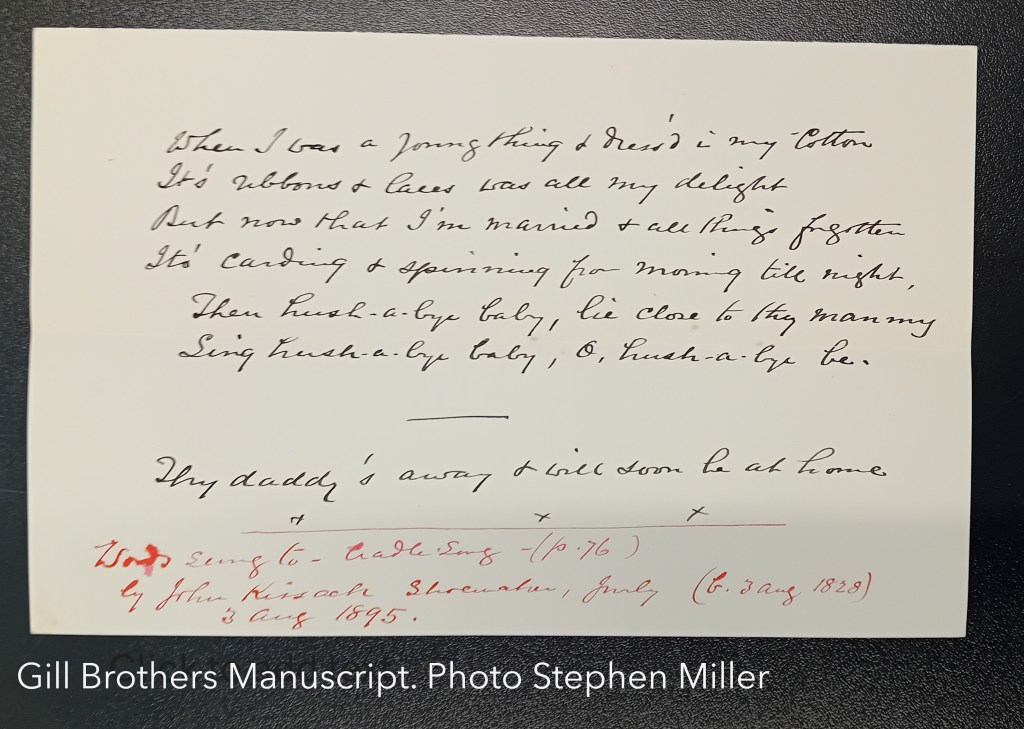
Stephen Miller has found John Kissack’s English lyrics amongst the Gill Brothers’ manuscript, these were collected on 3rd August 1895. “When I was a young thing, and dressed in my cottons, It’s ribbons and laces was all my delight. But now that I’m married, and all things forgotten, It’s carding and spinning from morning till night. The hush-a-bye baby, lie close to thy mammy, sing hush-a-bye-baby, oh Hush-a-bye be.” There is also the first line only of a probable second verse “Thy daddy’s away and will soon be at home.”
In 1896 this beautiful lullaby melody was published in two different books – Arthur William Moore’s Manx Ballads and Musicand William Henry Gill’s Manx National Songs with English Words. Much of Moore’s music, presumably also including this lullaby, was arranged for piano by Mary Louisa Wood, she was an indomitable force in the musical scene in the Isle of Mann, where a plaque in her honour describes her as ‘The Mother of Manx Music’. It is an adaption of Mary Louisa Wood’s piano arrangement which Chloe is currently playing on the lever harp.
In Manx National Songs with English Words the piano arrangement was composed by William Henry Gill, in it the tune has the title ‘Oh Hush Thee, My Babie’ which is noted as being a ‘Arrane ny Clean’ – Manx for cradle song.
Confusingly both the lyrics and the title in Gill’s publication are taken from Walter Scott’s poem ‘Lullaby of an Infant Chief’which were first published in his 1815 novel Guy Mannering. Scott’s poem was set to music multiple times throughout the 19th century, the most famous arrangement being by Arthur Sullivan. In the introduction Mr Gill made clear that the marriage between Scott’s words and this melody were his own:
‘Whatever may be the origin of this charming Cradle Song, it is so irresistibly suggestive of Scott’s well known words “O, Hush thee my babie” that the present alliance of words and music hardly needs an apology even to Sir Athur Sullivan’.
Scott’s lyrics commence sweetly with ‘Oh Hush Thee My Babie thy sire was a knight’, but rapidly descend into bloodshed and end with the chilling ‘For strife comes with manhood, and waking with day.’ Gill did allow himself some Manxification of the lyrics adding to Scott’s words ‘Oh horo hi ri ri cadul gu lo’ with a translation in the footnotes Sleep on till day’. These Manx additions are part of the most musically theatrical part of the arrangement, which has several unusual features including the tune transposed to a higher octave, a long 7 beat extended note, and a distinct short final phase which ends on the third rather than tonic.
Gill’s arrangement must have had some popularity. Thanks to the Manx National Heritage Channel you can find on Youtube a 1948 audio recording of traditional Manx singer Madge Watterson. She is singing in Manx what appears to be Gill’s arrangement of Scott’s poem, she apparently learnt this from her mother.
If you are delving into Irish sources, do get in touch. A very similar to the air ‘Rocking the Cradle’ was published in R.A. Smith’s The Irish Minstrel: A Selection from the Vocal Melodies of Ireland in 1825 (pp.94-95 ‘As I sat in the Vale’) and another version called ‘Rocking the Cradle’ as collected by Francis O’Neill and published in his Music of Ireland (1903) tune number 547. This suggests a common origin and I would like to find out more!
Anyway in 1961 the Manx tune was re-published yet again, this time with the lyrics associated with the tune today, or most of them. The book is The Children’s Song Book, and the composer is the prolific Hertfordshire born Elizabeth Poston. Poston was president of The Society of Women Musicians between 1955–1961 and remains a respected composer and arranger.
In The Children’s Song Book the credit for ‘Lullaby’ is ‘Traditional Manx Lullaby Tune arr. Elizabeth Poston’ and the lyrics given are:
“Oh hush thee my dove, Oh hush thee my rowan, Oh hush thee my lapwing, my little brown bird; Oh fold thy wings and seek thy nest now, Oh shine the berry on the bright tree: The bird is home from the mountain and valley, Oh hush thee my birdie, my pretty dearie.”
Poston’s inspiration was probably Louisa Wood’s arrangement as they share the same key – E flat Major, and there are none of Gill’s theatrical flourishes as can be found in his B Minor arrangement.
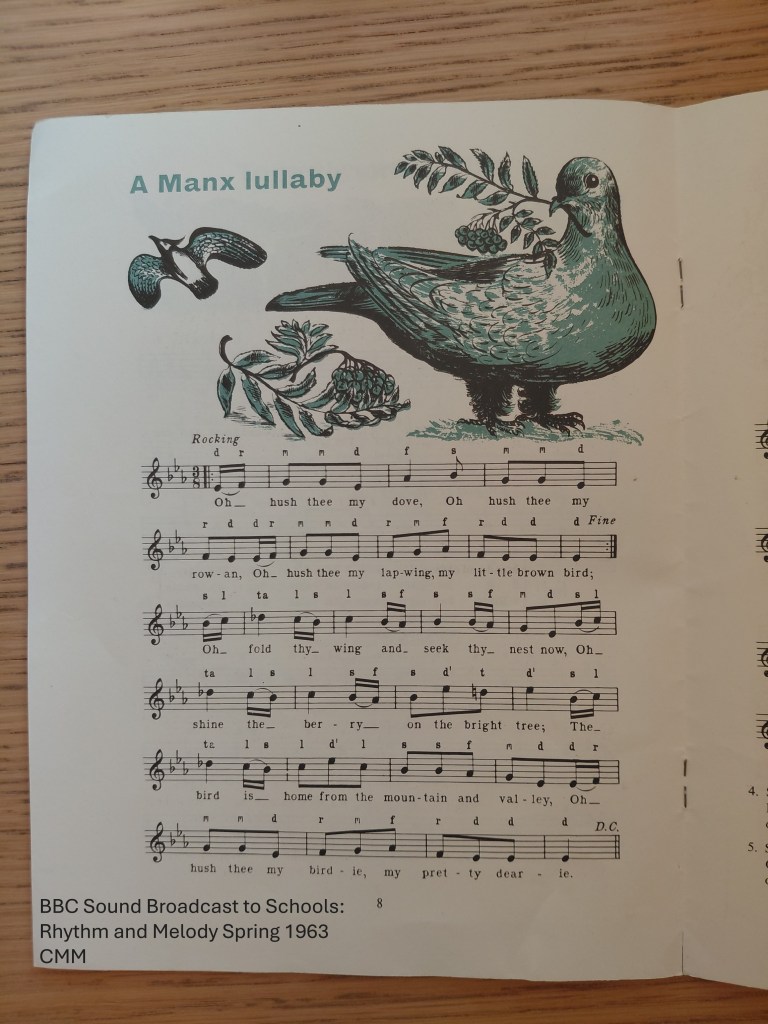
Poston’s version found favour with the BBC, featuring in a ‘Rhythm and Melody’ episode which was broadcast between 17th January and 28th of March 1963. A melody only version was published in the BBC’s accompanying booklet, with a back cover credit ‘Manx Lullaby, English Version by Elizabeth Poston’ and a reference to The Children’s Song Book.
Poston’s version was subsequently adapted for choirs by the Canadian composer Lori-Anne Dolloff. In 1997 she published a version for unison choir and piano as ‘Manx Lullaby’. As well as Poston’s version it would seem that Dolloff also had access to Gill’s arrangement as she made the sensible decision to scrap Poston’s slightly mediocre last line ‘O hush thee my birdie, my pretty dearie’ and replace it with the Manx inducement to sleep published by Gill’s ‘Horo hi ri ri” and Cadul gu lo’. It is Dolloff’s arrangement which appears to be the most popular on online lyric websites today. However if you want to credit the right people for this beautiful song why not try: Lyrics by Elizabeth Poston, Tune: Traditional Manx.
Thanks for getting to the end! If you want to be updated regarding my latest lullaby news and related research drop me a line to be added to my Lullaby e-mailing list 🙂
Acknowledgements:
Thanks to Stephen Miller, Chloe Woolley at Culture Vannin and Tiffany Hore at the Vaughan Williams Memorial Libary.
References: (All links correct as of 16/7/2026)
Fenella Bazin. “Mary Louisa Wood”. Biography. From ‘New Manx Worthies’, Manx Heritage Foundation/Culture Vannin, 2006. Manxmusic.com. Available at: https://www.manxmusic.com/history/biographies/wood-mary-louisa-1839-1925/
BBC. Sound Broadcasts to Schools: Rhythm and Melody Spring Term 1963. London: British Broadcasting Corporation, 1963.
Boosey & Hawkes, Elizabeth Poston. (1905-1987). Available at: https://www.boosey.com/composer/Elizabeth+Poston
W.H.Gill, Manx National Songs. London:Boosey and Co., 1896. pp.76-77. Available at: https://archive.org/details/manxnationalsong00gill/page/n3/mode/2up
W.H.Gill, The Original Collection of Manx Folk Music Completed in 1895 and 1896. See ‘Cradle Song’ p.104. https://manxmusic.com//media/History%20photos/Gill%20Collection%20Complete%20MS09702.pdf.
Stephen Miller: ‘“My book of Manx ballads at last published”; A. W. Moore’s “Manx Ballads and Music” (1896)’ Folk Music Journal, 2012-01, Vol.10 (2), p.207-233
Stephen Miller, ‘”Miss Gawne”: Mary Gawne as Singer’, Manx Notes, 29 (2004), pp.1-3. Available at: https://chiollaghbooks.com/manxnotes/MN029.pdf
Stephen Miller: ‘The Gill Brothers as Collectors’ (7): The Singers. Manx Notes, 57 (2006), pp.1-3. Available at: https://chiollaghbooks.com/manxnotes/MN057.pdf
Stephen Miller, Manx Folk Songs: From A.W.Moore’s “Manx Ballads and Music (1896)” Mannin: Chiollagh Books, 1994. Available at: https://chiollaghbooks.com/chiollaghbooksfirstseries/CBPOD01%20S.pdf
A.W.Moore, Manx Ballads and Music. Isle of Man, Douglas: J&R Johnson, 1896. pp.228-229, p.xxxiv. Available at: https://archive.org/details/ManxBalladsAndMusic
Oxfordshire History Centre, ‘Papers Relating to Elizabeth Poston, 1961-1987. Available at: https://heritagesearch.oxfordshire.gov.uk/records/P143/3
Elizabeth Poston, The Children’s Song Book. London: Bodley Head, 1961.
Madge Watterson, Manx language and dialect archive recordings: Skeealyn Vannin Disk 3 Track 13. Made by the Irish Folklore Commission in 1948. Available at: https://www.youtube.com/watch?v=QOcSQGB4gwY
Blog post last edited 6/10/2026
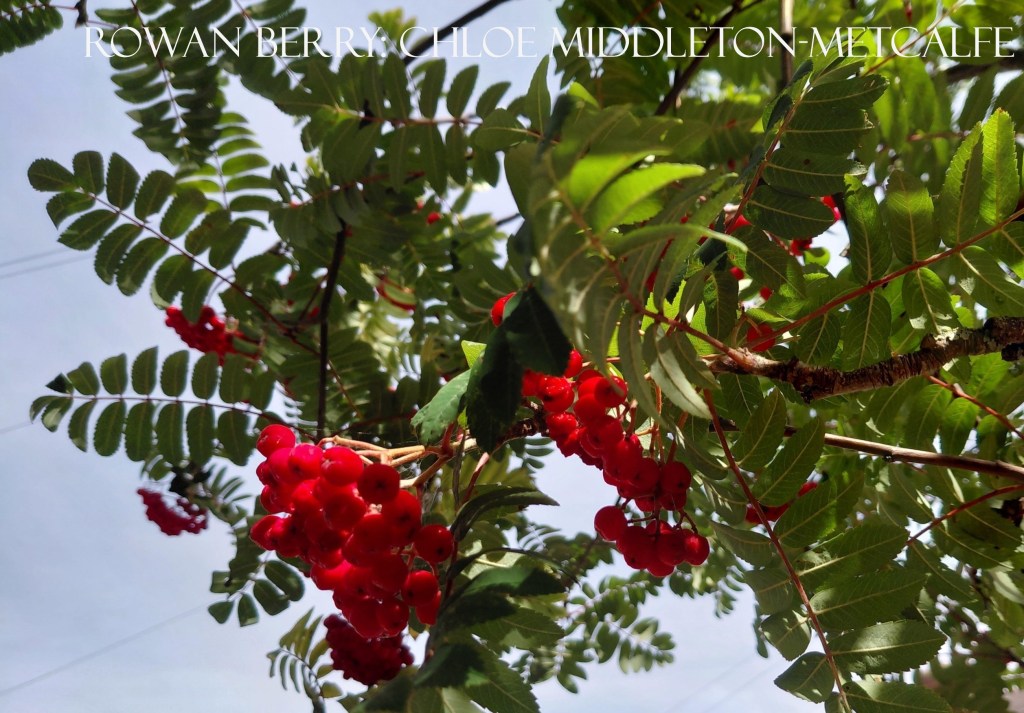
Photo of Rowan Tree, and BBC Sound Broadcast in Schools by Chloe Middleton-Metcalfe
Gill Brothers Manuscript page by Stephen Miller


Leave a Reply