5 Minute Read
I hope that it is not an unusually selfish thing for a teenager to buy a ‘present’ for a parent that is typically of more interest to the giver than the recipient. My choice was perhaps more unusual – a copy of George Deacon’s book John Clare and the Folk Tradition (1983). Once gifted I was able to squirrel it away to work my way through tunes and songs that took my fancy in the two or so years before leaving the family home.
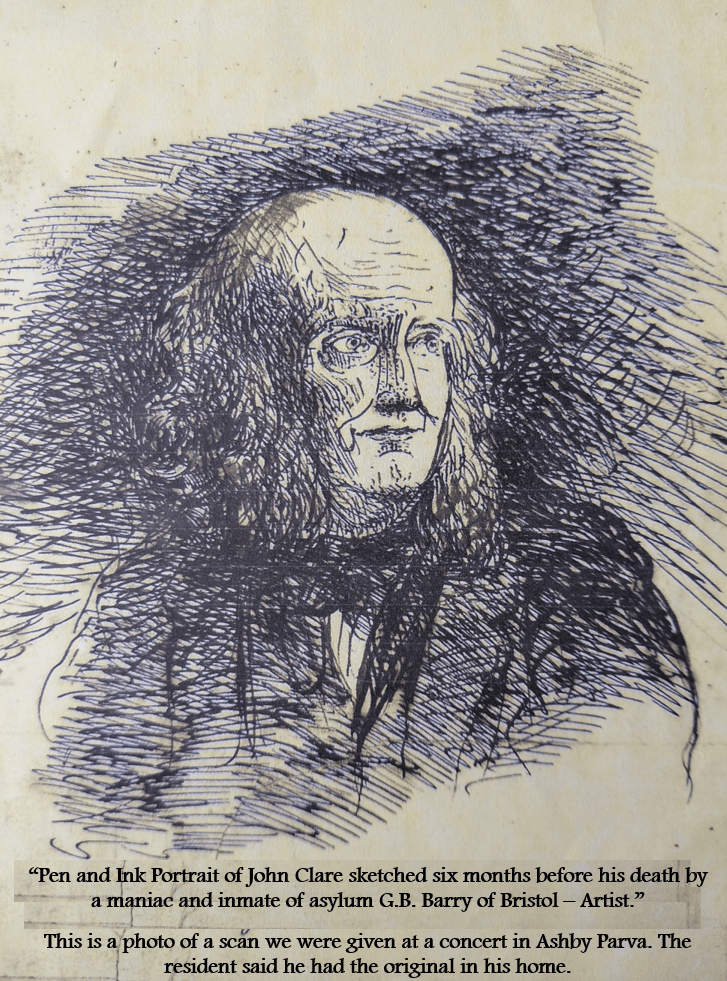
Best known today for his poetry, the shepherd, lime burner, and general agricultural worker John Clare (1793-1864) was also a fiddler and had a keen interest in songs. Clare was born in Helpston, then in Northamptonshire, and spent his last years in The Northampton Asylum (now St Andrews). There continues to be a reasonably strong interest in Clare and his work. I recently enjoyed reading the Man Booker Prize-nominated novel The Quickening Maze by Adam Foulds where Clare features prominently (2009).
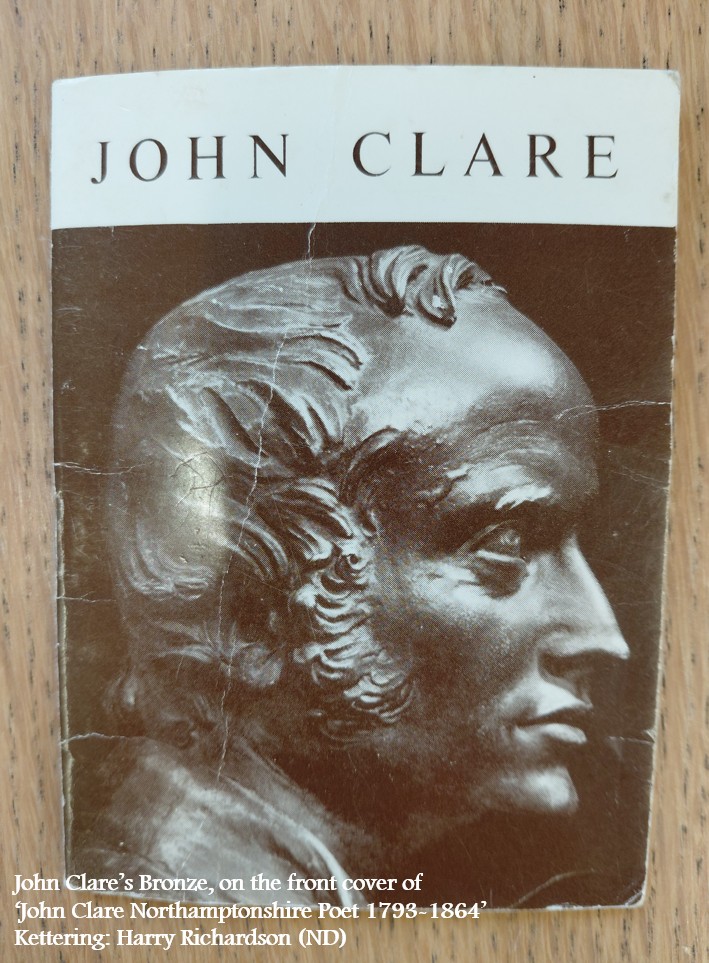
Dad always said my interest in John Clare came from the hours I spent lining up near his cast bronze bust in the atrium of All Saints Church, Northampton during my eight years in the girls’ choir there. I disagree, I think it stems from finding out that not only was John Clare one of the earliest collectors of song and music but he was also relatively local to me. If I am from anywhere, it would be Northamptonshire. I was born in Northampton General Hospital and Dad’s genealogical diggings have found eight generations of Northamptonshire-based Metcalfes. Whilst I now live in Buckinghamshire, I am still only 1km away from the county border.
Unlike many other regions of the UK Northamptonshire is not renowned for having a strong localised folk music tradition. To take dance our traditional groups include Northampton Morris Dancers who dance in the Cotswold style (mostly collected in Oxfordshire and Gloucestershire), Queen’s Oak who dance in the Border style (English/Welsh border), Rose and Castle who dance in the North West tradition (Lancashire and Cheshire) and Moulton Morris Men do a combination of all of these styles, but predominately Cotswold.[i]
In about 2014 I formed a family-trio, with my wonderful husband and concertina player Jake Middleton-Metcalfe and my lovely father Andrew Metcalfe. We decided that our first album project should be based on John Clare’s music. The final result was ‘The Windings of Their Wandering Song: A Tribute to John Clare’ which we, as Innocent Hare, released in 2025. We are a live band, used to the physical cues of playing together, some of the tracks are even semi-improvisatory, so it had to be a live album. Eleven of the twelve tracks were recorded in one take, down one condenser microphone. The title is taken from John Clare’s poem ‘Wild Bees’ which was written in the 1820s, and following the poetic theme the album also features Jake reading ‘January’ from Clare’s epic poem The Shepherd’s Calendar which was first published in 1827. This is not an attempt to reconstruct the music as Clare might have heard it. We see this very much as an artistic re-interpretation of the material and we like to think that Clare, who was also partial to re-writing the songs he collected, would have approved of the liberties we have taken.
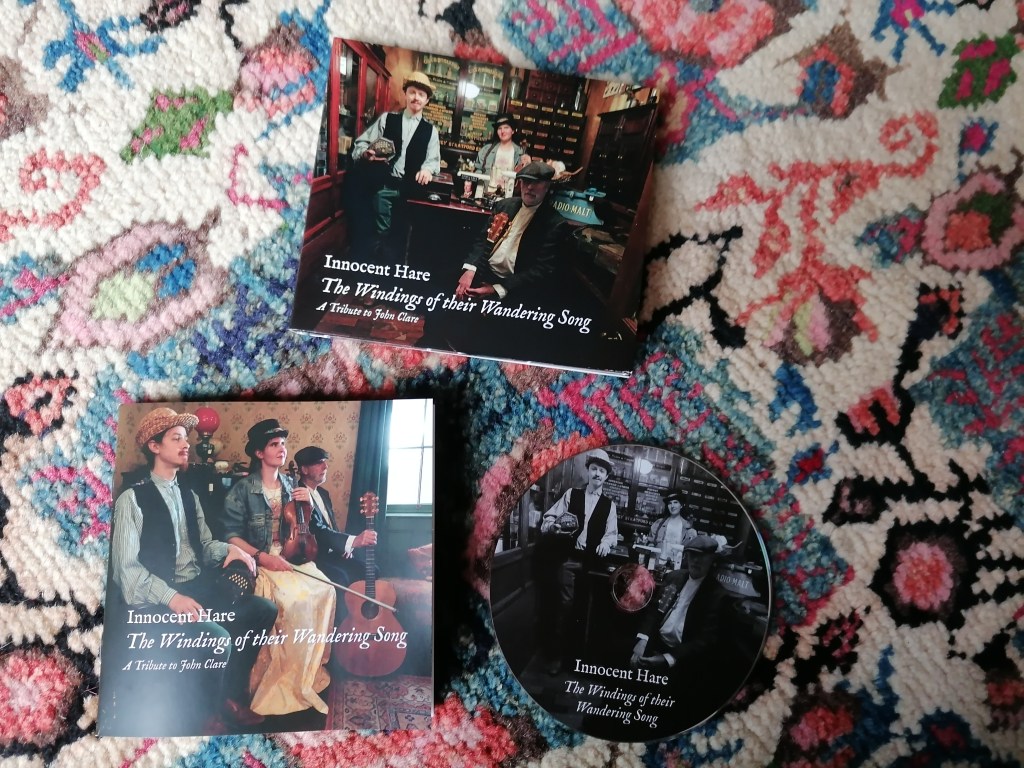
For each of the twelve tracks I took the time to add to Deacon’s research. You can find my full sleeve notes either on the physical album which can be purchased here, or the online sleeve notes can be read here:
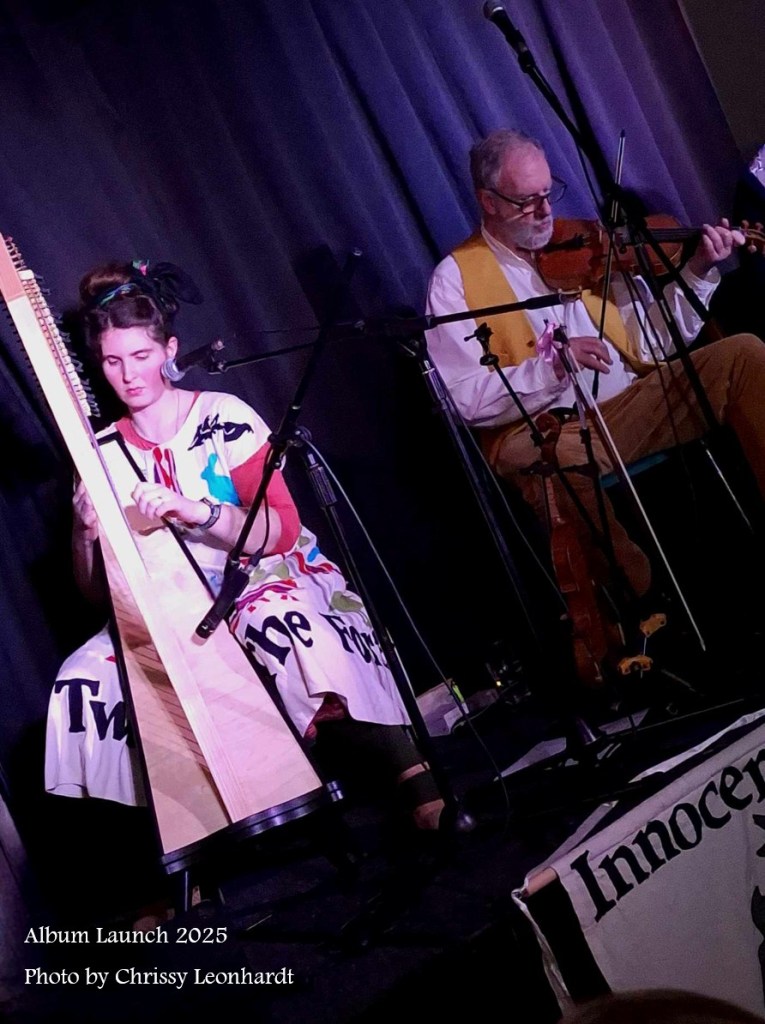
Alongside the English tunes you might expect to find in such collections (such as Robin Hood Rescuing Three Squires, Fisher’s Hornpipe and Speed the Plough) there were also many Pan-European links. Legalaw was originally written to support Irish resistance to English occupation, but its lyrics had become confused over time so that Clare himself described it as ‘A sensless song’ – our own version is more Cockayne than Republican. . I was so inspired that I actually made a dress featuring animals and the first line from this song which you can see in the performance photos. Classical aficionados will already know that March in Scipio was originally written by Handel for his opera Scipione which premiered in 1726. There are a number of Scottish tunes including those by Robert Petrie and Daniel Dow (Clare’s Delight, Clare’s Fancy) and for an Italic flair the charming La Bel Jean which was written by Francesco Xaverio Geminiani an Italian virtuoso violinist.
A personal favourite is Young Viola a version of the ballad ‘The Cruel Brother’ Clare’s version uses brother and lover interchangeably, making this one of the few collected ballads which might actually be about incest (Lucy Wan being the most famous). I was also delighted that Clare had a tune called Lullaby, this is one of a meagre handful of cradle tunes which I have been able to locate in historical English manuscripts.
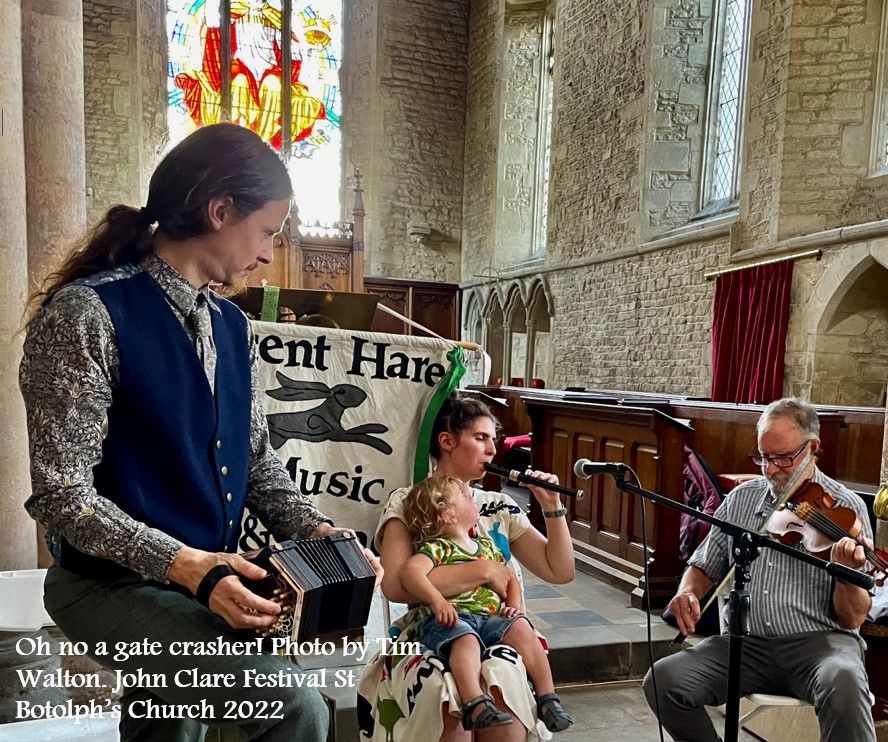
We were delighted to present our John Clare programme at St Botolph’s Church in Helpston at the Annual John Clare Festival in 2022, and later as a show, complete with poetry readings and biographical narration by actors Rob and Liz Gifford
Our album has received many positive reviews and radio play as far away as New Zealand courtesy of Kidnappers Ceilidh radio
My research and creative journey with John Clare didn’t finish here. During my English folk and fairy tales project I returned to John Clare as a historical source, and I re-recorded John Clare’s Lullaby for solo harp on my ever-forthcoming album of traditional lullabies. Follow me to receive more updates on these exciting projects!
To purchase a physical CD or download our album add-free visit Innocent Hare on BandCamp here – thanks a million.
Page last edited 14.10.2026
[i] Dances were collected from Northamptonshire though. See: Seven Midland Dances edited by Sibyl Clark (London: EFDSS, 1955). ‘The Yardley Gobion Morris’ by E. D. Mackerness, Journal of the English Folk Dance and Song Society, Vol. 7, No. 4 (Dec., 1955), pp. 216-217 and ‘Yardley Gobion Morris’, Maud Karpeles, Journal of the English Folk Dance and Song Society, Vol. 8, No. 1 (1956), pp. 44-45


Leave a Reply